
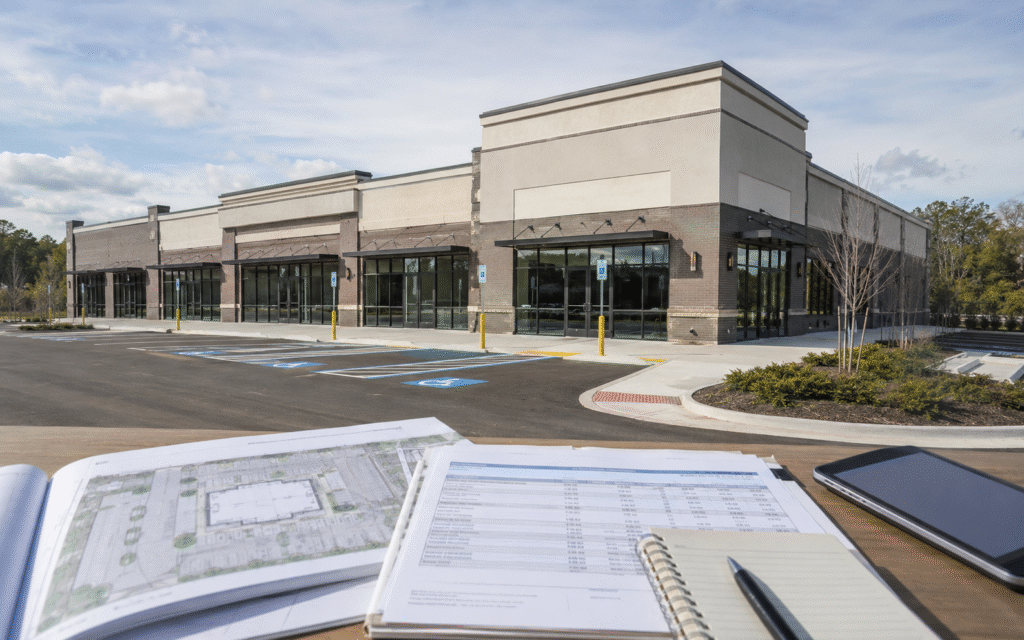
I wanted this project to work.
The market had strong demographics, limited healthcare access, a credible operating concept, and a location that supported the broader strategy. We had also identified an experienced developer who could acquire the land and execute the real estate, allowing us to focus more of our capital on launching and growing the operating business.
Then the lease proposal arrived.
The quoted base rent was $45.00 per square foot on a triple-net basis. After estimated taxes, insurance, and common-area expenses, the effective first-year occupancy cost increased to approximately $52.00 per square foot, or $208,000 annually for 4,000 square feet. The proposed lease also included 3% annual escalations over a 10-year term.
I declined it.
Not because the project lacked merit. Not because the developer was necessarily acting irrationally. And not because I had lost confidence in the market.
I declined it because the real estate economics no longer aligned with the operating business economics.
That experience reinforced a broader lesson that applies across commercial real estate:
A project is not feasible merely because it can be built. It must also generate sufficient durable income to cover its total costs, financing, and operating expenses.
The Project Had a Strong Underlying Thesis
The project was planned for an underserved metropolitan market with meaningful population growth, relatively strong household demographics, substantial private insurance coverage, and limited competing healthcare options.
The proposed concept included a healthcare-oriented development anchored by an approximately 4,000-square-foot operating facility. The remaining space would be leased to complementary healthcare and wellness providers that did not require the costs and infrastructure of a traditional medical office building.
The site strategy emphasized visibility, accessibility, nearby residential growth, proximity to established retail activity, and a tenant mix designed to support community-based healthcare services.
From an operating and community perspective, the concept made sense.
But a compelling market need does not justify unlimited development costs, nor does it make every proposed rent affordable.
That was the issue we had to confront.
I Was Looking at the Deal as a Principal, Not Just as a Lender or Risk Manager
I have spent much of my career evaluating transactions for lenders, credit committees, and risk-management organizations.
This time, I was sitting on the other side of the table.
The rent was not simply an underwriting assumption or an expense line in someone else’s model. It was a fixed obligation our operating company would have to pay every month while the business was hiring staff, purchasing equipment, building patient volume, and absorbing start-up costs.
The lease would begin on schedule.
The revenue might not.
That difference changes how a principal views risk.
A developer properly evaluates whether the rent covers land costs, construction expenses, financing, equity returns, lease-up exposure, and residual value.
The tenant has to ask a different question:
Can the operating business carry the full occupancy cost and still retain enough liquidity to execute its business plan?
Both questions matter. A transaction is not sustainable unless the answers align.
The Quoted Rent Was Only Part of the Cost
The $45.00-per-square-foot figure was the stated base rent.
But tenants do not pay base rent in isolation.
The estimated triple-net charges added another $7.00 per square foot. That brought the first-year occupancy burden to approximately:
- $180,000 in annual base rent;
- $28,000 in estimated pass-through expenses;
- $208,000 in total occupancy cost;
- or about $17,333 per month.
That amount would be payable before accounting for payroll, medical and operating equipment, insurance, technology, marketing, utilities within the suite, supplies, and working capital.
The proposed 3% annual increases also mattered. An aggressive opening rent becomes more difficult to manage over time as it compounds over a long-term lease.
This was not simply a negotiation over a few dollars per square foot.
It was a decision about whether the operating company should accept a long-term fixed burden that could weaken the business before it reached stabilization.
So I Rebuilt the Economics
I did not reject the proposal merely because the quoted rent appeared high.
I wanted to understand what the developer was solving for.
Using the available assumptions, I prepared a simplified analysis of a standalone 4,000-square-foot facility. The estimated cost basis included approximately:
- $760,000 for shell construction;
- $500,000 for land;
- $160,000 for partial sitework;
- for a total estimated development cost of approximately $1.42 million.
The developer even said I was close on the estimates. Based on that simplified analysis, the proposed lease produced an estimated return on cost of approximately 13.1% in Year 2, increasing to roughly 14.7% in Year 5 and 16.5% in Year 10 as rent escalated.
The analysis was not intended to recreate every element of the developer’s broader project. The full development included additional space, common infrastructure, leasing exposure, and other risks that would affect the complete return profile.
It was a reasonableness test.
And the test indicated that the proposed rent was materially higher than what I believed was necessary to support the smaller facility, particularly given the pad-ready condition, limited specialty construction requirements, and the risk being transferred to a start-up operating business.
My conclusion was that a base rent closer to $36.00 to $38.00 per square foot would better balance the developer’s return with the tenant’s ability to operate sustainably. And I believed that was even high for the market, but I wanted to extend beyond fairness to get the deal done.
I wanted the project to proceed.
But wanting a project to work is not the same as proving that it works.
Required Rent and Supportable Rent Are Different Numbers
This distinction is central to development feasibility.
Required rent is the rent needed to support the developer’s economic model, including:
- land and construction cost;
- debt service;
- equity return;
- contingency;
- lease-up risk;
- and residual value.
Supportable rent is the rent justified by:
- market comparables;
- tenant economics;
- location quality;
- competing space;
- operating margins;
- lease concessions;
- and the value the space provides to the occupant.
Those two figures may align.
In this case, they did not.
A project does not become feasible simply because a spreadsheet requires a higher rent. The market does not automatically adjust to the developer’s cost basis.
The same principle applies beyond tenant leases.
A projected sales price does not become achievable because it is required to produce the sponsor’s target return. A permanent loan amount does not become available because it is needed to repay the construction loan. An appraisal does not create cash flow that the property cannot produce.
The required outcome and the supportable outcome must be tested separately.
Today’s Cost Environment Makes That Alignment Harder
The pressure is not limited to one transaction.
LakeRock’s CRE Property and Construction Cost Monitor tracks the construction inputs and property-level operating pressures that directly affect development feasibility, including materials, contractor pricing, utilities, inflation, and other costs that influence both the construction budget and the stabilized operating statement.
The June 2026 Monitor showed renewed pressure on both sides of the equation. Nonresidential construction-goods inputs increased approximately 2.4% during May, while construction-service inputs rose 0.3%. Broader inflation and elevated electricity costs also reinforced the need to test actual utility, maintenance, insurance, tax, labor, and lease-recovery assumptions.
That matters because a development may be pressured twice.
It can cost more to build the property, while the tenant or owner may also face higher expenses after the property opens.
Financing adds another layer. Elevated benchmark rates continue to affect construction-loan interest carry, permanent-loan proceeds, valuation assumptions, and required development yields.
LakeRock’s Weekly Rate & Capital Markets Signal provides the complementary financing view by tracking SOFR, Treasury yields, credit spreads, CMBS stress, and the implications for CRE underwriting, refinancing, and capital structure. Together, the Signal and the CRE Property and Construction Cost Monitor help evaluate both sides of the feasibility equation: what it costs to build and operate the property, and what current financing conditions will support.
Even when credit spreads remain orderly and capital is available, a transaction can still fail if the project cannot generate sufficient income to cover the combined costs of construction, operations, and financing.
Capital availability is not the same as project feasibility.
Readers evaluating development budgets, rehabilitation plans, lease economics, or cost-to-complete exposure should review the latest CRE Property and Construction Cost Monitor for current data and LakeRock’s underwriting interpretation.
Track the Costs Behind the Feasibility Gap
LakeRock’s CRE Property and Construction Cost Monitor tracks construction inputs, operating-cost inflation, utilities, and other expense pressures affecting CRE development and property performance.
Why Good Projects Stop Penciling
Most projects do not become infeasible because of one catastrophic assumption.
More often, several manageable pressures accumulate.
Construction cost increases.
The required rent rises.
The tenant resists the higher occupancy burden.
Lease-up takes longer.
Interest carry increases.
Stabilized NOI falls below projections.
Permanent-loan proceeds decline.
The equity requirement grows.
Each issue may appear manageable by itself. Together, they can break the transaction.
That is why development feasibility cannot be evaluated by a single metric.
A well-supported construction budget does not prove that the property will create sufficient value.
Strong demographics do not prove that tenants can pay the required rent.
A willing lender does not prove that the takeout will repay the construction loan.
A credible tenant does not prove that the tenant can withstand the full occupancy burden.
The project must work as an integrated system.
What Developers and Investors Should Test
Developers and investors should begin with a practical question:
What is the minimum viable version of the project?
The answer may involve reducing the initial scope, phasing the development, simplifying the design, sharing infrastructure, or delaying components that do not immediately support revenue.
They should also explicitly measure the gap between the required rent and the supportable rent. That difference should not be hidden within optimistic leasing assumptions or future rent growth projections.
Contingency deserves the same discipline. It should absorb unforeseen construction events—not compensate for a budget that was underfunded from the start.
Finally, the capital plan should identify what happens if the project costs more, leases more slowly, or produces less permanent financing than expected.
A project is fragile when every assumption must work exactly as planned.
What Construction Lenders Should Test
Construction lenders should look beyond whether the transaction meets the initial loan-to-cost threshold.
The more important questions include:
- Are the rents supported by executed leases and credible market evidence?
- Can the anchor tenant support the full occupancy cost?
- Is the building program appropriate for the market and intended use?
- Is the interest reserve sufficient under a slower schedule or higher-rate scenario?
- How much of the construction budget is actually bought out?
- Who funds overruns or a takeout shortfall?
- Does the sponsor retain sufficient liquidity after the initial equity contribution?
- Will stabilized NOI support permanent debt under current DSCR, debt-yield, and valuation requirements?
Construction risk does not begin with the first draw.
It begins when the project assumptions are established.
What I Took Away From the Decision
The central lesson was not that the developer asked for too much or that the tenant refused to pay market rent.
The lesson was that the real estate economics and the operating economics were not aligned.
The project had a credible community need, strong demographic support, a viable operating concept, an identified site, and an experienced development counterparty.
Those strengths mattered.
They did not eliminate the feasibility gap.
The right decision was not to force the transaction because we had already invested time, energy, and conviction in the concept.
The right decision was to preserve capital, reject an unsustainable structure, and improve the development model.
That experience now informs LakeRock’s broader development approach: identify markets with unmet demand and strong fundamentals, define the minimum viable real estate solution, and align construction cost, occupancy expense, financing, and operating capacity before capital is committed.
The objective is not simply to build.
It is to create projects that remain economically durable for the developer, operator, lender, investor, and community.
Closing View
Higher construction costs do not automatically justify higher rents.
Strong demographics do not automatically make a project feasible.
And a compelling operating use does not eliminate capital-structure risk.
Good projects stop penciling when the cost to create the property exceeds the income the property and its occupants can sustainably produce.
This article is part of Inside the Commercial Real Estate Credit Room™, LakeRock Capital’s broader platform for CRE credit, underwriting, market intelligence, governance, development risk, and institutional decision-making. The Credit Room is designed to help lenders, investors, developers, sponsors, and advisors connect market conditions to the assumptions, structures, and decisions that ultimately determine whether a transaction holds up.
The discipline is straightforward:
Underwrite the construction cost. Underwrite the rent. Underwrite the tenant. Underwrite the takeout. Then determine who carries the risk when those assumptions do not align.
That is how a promising concept becomes an executable development—or an expensive mistake avoided.
Managing Partner, LakeRock Capital
Derek P. Pollard is the Managing Partner of LakeRock Capital and a former enterprise commercial real estate credit-risk executive, CRE lender, workout officer, and Federal Reserve examiner. His work focuses on CRE underwriting, portfolio risk, capital structure, governance, development feasibility, and institutional decision-making.
More From Inside the CRE Credit Room™
Continue with current LakeRock research and decision-focused resources covering construction costs, capital markets, underwriting, and commercial real estate credit.
CRE Property and Construction Cost Monitor
Track construction inputs, operating-cost inflation, utilities, and other pressures affecting development feasibility, property cash flow, and capital requirements.
Weekly Rate & Capital Markets Signal
Follow SOFR, Treasury yields, credit spreads, CMBS stress, and financing conditions shaping CRE underwriting, refinancing, and valuation.
Inside the CRE Credit Room™
Explore LakeRock insights on underwriting, construction risk, capital decisions, governance, and institutional CRE decision-making.
Bring Greater Clarity to Your Next CRE Decision
Discuss a CRE credit, portfolio, investment, development, or underwriting-governance need with LakeRock Capital.